Showing posts with label My Publications. Show all posts

Monday, October 18, 2021

Book Review - The Book in Africa: Critical Debates by Caroline Davis and David Johnson

The Book in Africa: Critical Debates by Caroline Davis and David Johnson explores the publishing history of manuscripts in Africa.

The following book review was published by Research in African Literatures journal in 2021.

Citation: Paul, Aditi (2021), "The Book in Africa: Critical Debates by Caroline Davis, David Johnson Review by Aditi Paul", Research in African Literatures, 51(4): 251-253.

In 2012 at the Institute of English Studies, London University, “The Book in Africa Symposium” was held. Some of the presentations made in that symposium coupled with new case studies from across Africa on the manuscript tradition led to the publication of The Book in Africa: Critical Debates. In addition, this book is part of Palgrave Macmillan’s series titled New Directions in Book History that is exploring, documenting, and reassessing the neglected global history of print, script, and post-print cultures from antiquity to the twenty-first century.

The Book in Africa is an invaluable overview of the marginalized body of African scholarship that has been a by-product of European missionaries, colonial administrators, and traders. The book is divided into three sections and each chapter interconnects sociohistorical circumstances and literary scholarship: (1) the printing of oral manuscripts in different African contexts, (2) the relationship between the book and African politics and economics, and (3) the production, circulation, and reception of literary texts in Africa.

In the first section, Archie L. Dick examines reading culture from 1780 to 1840 in the Cape of Good Hope. He notes that the circulation of copied texts was widespread among the Cape inhabitants. Whether it was newspapers, religious scriptures, political propaganda leaflets, or schoolbooks, reading materials before the advent of the printing press were copied texts and reflected religious, social, class, and language divides. The author then claims that in the early 19th century, when print capitalism emerged, the motive for reading and circulating printed text changed to economic gains. Fawzi Abdulrazak charts the advent of the printing press in Morocco. He analyzes four phases of the government involvement in publishing: (1) 1865–71, when printing, finance and marketing, and quality control was under government jurisdiction; (2) 1871–97, when the government abandoned direct supervision but used printing for propaganda purposes and private citizens bore the responsibility; (3) 1897–1908, when publishers sponsored books for both charitable and profitable purposes and the government assumed the role of censor; and (4) 1908–12, when the government applied stringent controls over printing and exploited it for political drives. Likewise, Alessandro Gori, in his chapter, explores different phases in Ethiopian history that shaped Islamic printing. He argues that due to the intervention of the Emperor, print culture in Ethiopia had slower progress as compared with the countries wherein printing under Christian missionaries was flourishing. Shamil Jeppie captures the oral, written, and print tradition in Timbuktu. He discusses Ahmad Bul’araf, who turned Timbuktu into a repository of books through his collection of manuscripts.

In the second section, David Johnson challenges Benedict Anderson’s concept of imagined community and questions the possibility of print culture contributing to postcolonial South African nation-building. He argues that despite the reality reflected and realization among citizens, print literature lacked ideological influence on nation-building and, therefore, had a negligible impact. Carol Davis traces the history of African print culture of a British publisher: Longmans. Davis argues that Longmans circulated linguistic, historical, and anthropological knowledge about Africa through London-based publications and African education system, while indigenizing staff and publications and allowing governments, African authors, and educational institutions to establish alliances with Longmans. But what remains a mystery is the failure to keep Longmans publishing ventures and profits in Africa on record. Davis concludes by stating that the fragmentary remnants of Longmans’ commercial business in Africa is unbelievable and could be a conscious veil over the company’s history with reasons unknown. On the other hand, Giacomo Macola and Jack Hogan’s chapter discusses Lozi thinkers and how they used books as tools for propagating Lozi ethnicism. The authors argue that while histories and ethnographies of Lozi were reflected in vernacular ethnographic works, upon the advent of electronic material, the trend drifted away from postcolonial literature. Elizabeth Le Roux explores Witwatersrand University Press (WUP) and narrates how sociopolitical, economic, and ideational factors exert pressure on publishing activities of university presses. Le Roux contends that while WUP gained public trust because of its political mission and anti-apartheid publishing, the bibliographic analysis reveals that WUP never resisted government censorship and hence was not a radical, oppositional, and independent press.

In the last section, Ruth Bush and Claire Ducournau reflect on the role of a literary prize—Grand prix litteraire de l’Afrique noire—by the Association des ecrivains de langue francaise (ADELF). The chapter argues that the prize culture by ADELF for African writing in the French language moved beyond dominant ideas despite adhering to the politics of French cultural hegemony. Nourdin Bejjit examines the evolution of African literature and the success of Heinemann Educational Books (HEB). He explores the journey of Ngũgĩ wa Thiong’o and argues that his shifting political ideas were synchronous with his relationship with HEB. In the last chapter, Joyce Ashuntantang discusses Anglophone Cameroonian writers of the 1960s and 1970s and their struggles with European, African, or Francophone Cameroon publishers. Ashuntantang argues that disappointed Anglophone Cameroonian writers established their own publishing houses and met success in publishing high-quality scholarly and creative writing. However, the advent of the internet encouraged Anglophone Cameroonian authors to self-publish and digitally promote their writings on social media sites and blogs. And while the “death of the book” is far away, the digital revolution did transform publishing and the dissemination of literature for authors.

The Book in Africa offers a commendable array of historical research that enables readers to comprehend the events at a given point in time. The book can be a reference book for those unfamiliar with the pre- and postcolonial history of publishing houses in Africa and the conflicting issues with which the writers jostled. Since the book peeks into the unexplored archives and overlooked studies that are the evolutionary links in the histography of African book culture, it does play a role in inciting interest in the lovers of African studies, postcolonial studies, and the history of print media.

Saturday, March 13, 2021

Book Review: Censorship and Propaganda in World War I: A Comprehensive History by Eberhard Demm

Does World War still interests you?

Then the book Censorship and Propaganda in World War I: A Comprehensive History will excite you.
Filled with secret messages and the use of propaganda for attaining victory in WWI, this book is a must read. 

Over here I have reviewed this book. And it was published by Journalism & Mass Communication Quarterly. 

Citation: Paul, Aditi, “Review of Eberhard Demm, Censorship and Propaganda in World War I: A Comprehensive History”, Journalism and Mass Communication Quarterly, 98 (1), March 2021.

For a free pdf copy of the book review leave a message below.

Friday, September 25, 2020

Regional Cooperation in South Asia: Exploring the Three Pillars of Regionalism and their Relevance

The Journal of Indian and Asian Studies published my paper titled "Regional Cooperation in South Asia: Exploring the Three Pillars of Regionalism and their Relevance" in Volume 01, Issue 02 (July 2020). 


Abstract -

The lofty ideals penned by the heads of the South Asian states at the birth of the South Asian Association for Regional Cooperation (SAARC) reflect a vision for promoting mutual trust and understanding in South Asia. But the member states have fallen into the intricate web of power balancing games, fluctuating economic growth and volatile ethnic and religious conditions that has marred the potential gains from regionalism. In such a scenario, while SAARCs snail-like progress continues without any remarkable achievements, there has been a rise of new regional organizations that has not only renewed our attention towards economic liberalization and the benefits accrued from multilateral economic cooperation but has also put into question the fundamentals of regionalism. The paper situates regionalism in acts of cooperation that are not isolated and discrete from each other but rather form a pattern of interconnecting expectations about the future of the alliance and the assumptions on legitimate activities. The paper argues that regionalism is a multi-faceted task and involves political harmony, economic interdependence and common identity as the three pillars. But regionalism in South Asia encourages economic interdependence and proscribes political integration and common values and norms. As a result, the attempts at regionalism in South Asia are conceptually narrow, limited in agenda and inadequate to address the issues of regional peace and security.

To Access - https://www.worldscientific.com/doi/10.1142/S2717541320500084

Citation - Paul, Aditi, 'Regional Cooperation in South Asia: Exploring the Three
Pillars of Regionalism and its Relevance', Journal of Indian and Asian
Studies, 1 (2), July, 2020.

Friday, July 24, 2020

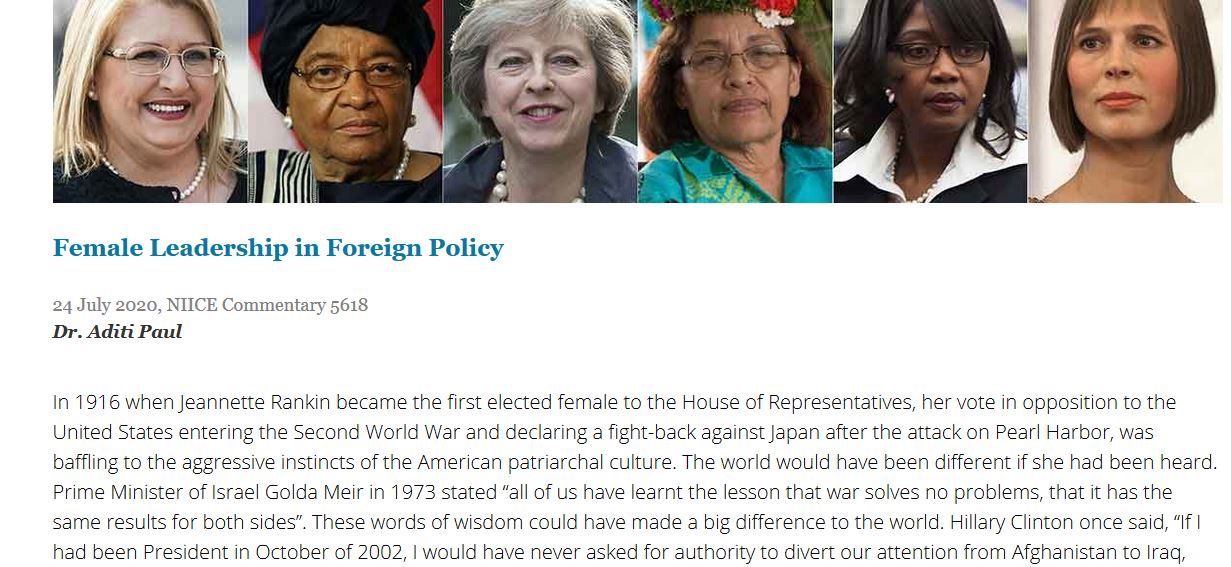
Female Leadership in Foreign Policy


Recently I participated in Nepal Institute for International Cooperation and Engagement (NIICE) International Women Summit on 18 July 2020. I spoke on Women in Foreign Policy.

It can be viewed in YouTube Session 8 .

The extended version of that paper presentation got published as an article. Click to Read.

Citation: Paul,Aditi (2020), "Female Leadership in Foreign Policy", Nepal
Institute for International Cooperation and Engagement. URL - https://niice.org.np/archives/5618?fbclid=IwAR0y5hdkzzssfMs-nXqV40b5Y1Ln1WyP4imICwnCT0iBbVoTWNBFxhwSpAQ


Tuesday, July 21, 2020

Book Review of Christian-Muslim Relations: A Bibliographical History. Volume 8. Northern and Eastern Europe (1600-1700)

I reviewed a book on Christian-Muslim relations. It is published by Acta Via Serica - Journal for Silk Road and Central Asian Studies, Keimyung University, South Korea.

Click to read: https://www.actaviaserica.org/subnew_52.php?mode=view&idx=59&find=&search= 

Citation: Paul, Aditi, 'Review of David Thomas and John Chesworth (eds.) Christian-Muslim Relations: A Bibliographical History. Volume 8. Northern and Eastern Europe (1600-1700)', Acta Via Serica, 5 (1), June, 2020, pp. 199-213.


Friday, June 12, 2020

Book Review of New Authoritarianism: Challenges to Democracy in the 21st Century

New Authoritarianism raises serious questions about the efficacy of democracy and authoritarianism. The book gathers an impressive collection of political analysts to outline the retreat of democratic traditions and rise of authoritarianism in countries like Hungary, Kenya, Poland, Russia, and Turkey. Well-researched and constructed, New Authoritarianism follows a logical structure in each of its chapters that reflects the expertise of the authors. Each case-study provides systematic insights into countries that evolved from dictatorship to democracy, only to revert to a new form of authoritarianism (referred to in various places as controlled democracy, delegative democracy, electoral authoritarianism, and illiberal democracy).

For the complete book review click: Jerzy J. Wiatr (ed.) (2019), New Authoritarianism: Challenges to Democracy in the 21st Century, Toronto: Verlag Barbara Budrich Publishers.

Citation: Paul, Aditi (2020), Review of Jerzy J. Wiatr (ed.) New Authoritarianism: Challenges to Democracy in the 21st Century, Nepal Institute for international Cooperation and Engagement. URL: https://niice.org.np/archives/4926.

The review has been re-published by Nepal's leading news agency Khabarhub.


Tuesday, April 7, 2020

India-Nepal Relations - The Kalapani Contention


When the recent alterations in the political map of India was published on 31 October 2019 indicating two newly formed Union Territories – Jammu and Kashmir, and Ladakh, the long-standing controversial border issue between Nepal-India came to the spotlight and sparked a sudden momentum in Nepal over the Kalapani issue.

Whether border is natural or artificial, clear or blurry, it is an identity marker and creates loyalties within its territory. Therefore, nationalist fervor for one’s own stable territory and border has been the reigning issue in the history of world politics.

Mapping the origin of the Kalapani issue and the unresoved status of the India-Nepal border, I argue  in this article that At the time when China has resolved its ‘land border’ with all its neighbours, debarring Bhutan and India, India having border disputes with many of its neighbour do not fit in its ambition to rise as a regional and global power.

Citation: Paul, Aditi (2020), “Kalapani Questions: Searching Peace in Turbulent Waters” Nepal Institute for International Cooperation and Engagement, 7 April 2020, URL: https://niice.org.np/archives/3957.     

Monday, March 23, 2020

SAARC and COVID-19

At a time when the world is jostling with the dreaded COVID-19, and people are left with no choice but quarantine themselves at home, my published commentary on the options for regional organizations, especially SAARC, makes for not just an interesting read but offers an insight into the challenges lying ahead of the states leaders.


Citation: Paul, Aditi (2020), “SAARC Leaders Video Conferencing on COVID-19, But is it Enough?”, Nepal Institute for International Cooperation and Engagement, 23 March 2020, URL: https://niice.org.np/archives/3515

Saturday, November 16, 2019

India Quit RCEP: Is It a Good Decision?

Ever Since RCEP was mooted, India has been its ardent supporter. But due to some non-compliance issues and RCEP not able to accommodate Indian apprehensions, India chose to quit RCEP.


So, is the decision right?


My article got published on this issue.


Citation: Paul, Aditi (2019), “India Has Old Ties with ASEAN; Should Have Treated RCEP as an Opportunity”, South Asia Monitor, 16 November 2019, URL: https://southasiamonitor.org/news/india-has-old-ties-with-asean-should-have-treated-rcep-as-an-opportunity/sl/31197?fbclid=IwAR2KpankE1CJrlxlds9CtqanqxrrWuFAM88iNF9IGNva4sk6SY1GlJ8T5kQ


Saturday, November 2, 2019

What is RCEP and Why India is Bothered?

For those reading on regional trade relations, the Regional Comprehensive Economic Partnership (RCEP) would not come as a surprise. For ASEAN, RCEP opens doors to many more opportunities than what exists now. It has the potential to push liberal economic policies and strengthen ASEAN trade connectivity and facilitation schemes.

Therefore, at the 7th ministerial meeting held on September 8, 2019, in Bangkok, an urgency was shown to conclude this trade agreement. But India is quite reluctant.

Why?

Click to read my arguments in the article published by the South Asia Monitor.

Citation: Paul, Aditi (2019), "RCEP: Will Deeper Economic Regionalism Benefit India?", South Asia Monitor, 2 November 2019, URL: https://southasiamonitor.org/news/rcep-will-deeper-economic-regionalism-benefit-india-/sl/31076


Saturday, June 22, 2019

Why Did ISIS Choose Sri Lanka for Terrorist Attack?


On 21 April 2019, Sri Lanka witnessed terrorist attack after a decade long peace.


Why?


After ISIS has claimed the responsibility, rather than solving the trouble, a lot of questions have erupted.


Why was Sri Lanka chosen for the attacks?
How did ISIS successful orchestrated an attack of this scale?
How were the local groups trained and organized by ISIS?
What were the shortfalls on the state government's part?


Wanting to discuss these aspects, I wrote a commentary.


Click to read for free: https://niice.org.np/archives/2389.


Citation: Paul, Aditi (2019), “Act-Act Only Way to Peace: Rethinking Strategy for the Region”, Nepal Institute for International Cooperation and Engagement, 3 June 2019, URL: https://niice.org.np/archives/2389.     

Tuesday, March 5, 2019

India's Options Post- Pulwama

India conducted a pre-emptive strike on a training camp of Jaish-e-Mohammad in Balakot on 26 February 2019. This was in response to the 14 February 2019 incident when 40 CRPF personnel were shot during peacetime in the Pulwama District of J&K. Discussing the situation and the options laid in front of India that are beyond surgical strikes and war, I wrote an article.


Citation: Paul, Aditi (2019), "India's Reinvigorated Diplomacy: Aftermath Pulwama Attack", Nepal Institute for International Cooperation and Engagement, 5 March 2019, URL: https://niice.org.np/archives/2368.


Wednesday, January 9, 2019

Pakistan Gets Closer to China

December 2018, Indian Military Review published my article titled - Disillusioned with US, Pakistan Gets Closer to China, Russia.


Indian Military Review Dec 2018 Issue was also part of the Military Literature Festival at Chandigarh held in 7-9 Dec 2018.


Citation - Paul, Aditi (2018), “Disillusioned With US, Pakistan Gets Closer to China, Russia”, Indian Military Review, 12(9): 51-52.


To get a soft copy of my article or this magazine, get in touch with me through the Contact Form. I will be happy to email a free pdf.

Sunday, December 16, 2018

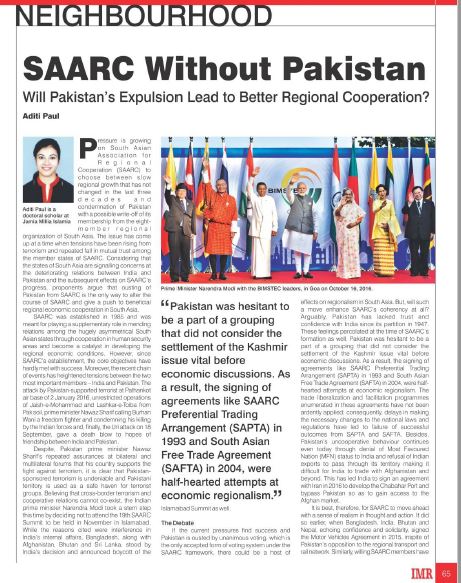
What If Pakistan Was Not A Member of SAARC?

Some time back I wrote an article on the concept of reimaging SAARC and considering an idea wherein Pakistan was not a member of South Asian Association for Regional  Cooperation (SAARC).


It was published by Indian Military Review, a monthly magazine on political and military affairs.


Citation - Paul, Aditi (2016), “SAARC without Pakistan”, Indian Military Review, 7(11): 65-66.


To have a free access to the whole article, get in touch with me through the Contact Form. I shall be glad to send over the PDF.


Friday, October 12, 2018

My Chapter on Migration and Human Security Got Published

Recently, I wrote on the issue of migration worldwide and how it impacts human existence and security.


It was a chapter contribution for an edited volume called Migration and Human Security in South Asia.


My chapter is titled "Migration and Human Security: Meaning, Triggers and Consequences"


If you wish to read my complete chapter, kindly get in touch with me through the Contact Me Form. I would be happy to mail a free PDF.

Friday, July 13, 2018

India - Saudi Arabia Bilateral Ties

India and Saudi Arabia have economic and strategic interests. So, when in 2016 Indian PM Modi visited Saudi Arabia, it was expected to cement even stronger ties.


Elaborating on this issue more, I discussed it in an article published by South Asia Monitor.


Citation - Paul, Aditi and Pramod Jaiswal (2016), "India-Saudi Arabia Bilateral Ties: Time to Harness Their Potential", South Asia Monitor, URL: https://southasiamonitor.org/news/india-saudi-arabia-bilateral-ties-time-to-harness-their-potential/sl/16208


Thursday, February 8, 2018

What Is CPEC and How It Impacts India?


While popular discontent and political opposition continue to affect CPEC, it could become a big concern for India especially since it will run through a territory that India legitimately claims to be its own.


Voicing concerns on this issue, in 2016 my article got published on the Chinese sponsored project called CPEC and its repercussion on India.


Citation: Jaiswal, Pramod and Aditi Paul (2016), "China-Pakistan Economic Corridor: Should India Worry?", South Asia Monitor, URL: http://southasiamonitor.org/detail.php?type=sl&nid=17232.


Tuesday, February 6, 2018

What are the Benefits of India and Iran Relations?

In 2016, Indian Prime Minister Narendra Modi made a 2-day visit to Tehran to sign the Chabahar Agreement.

To analyse this occasion, I wrote an article titled "Renewal and Revival: Blossoming Strategic Ties Between India and Iran"

The article argues that India and Iran have long been close economic and strategic partners. Despite the tight sanctions that were imposed on Iran due to its nuclear weapons programme, India never ceased its bilateral links with it and pursued discussions on transport networks among other things. The withdrawal of the sanctions by the western community has only renewed and revived the prospects of India-Iran relations, with the signing of the Chabahar port agreement being a marker of their deepening association.

Citation: Paul, Aditi and Pramod Jaiswal (2016), "Renewal and Revival: Blossoming Strategic Ties Between India and Iran", South Asian Monitor, URL: http://southasiamonitor.org/detail.php?type=inthenews&nid=17301.

Sunday, February 4, 2018

Friday, February 2, 2018

Pakistan Published my Opinion !

In 2016 my co-authored newspaper article was published by Pakistan's first independent weekly paper called The Friday Times.


The title of the piece is "Modi Decides to 'Think West'".


Citation: Paul, Aditi and Pramod Jaiswal (2016), "Modi Decides to 'Think West'", The Friday Times, May 27, URL: http://www.thefridaytimes.com/tft/modi-decides-to-think-west/.